Sunday, December 27, 2009

Assumptions and Guesswork

A New York Times editorial outlines and opines on the differences between the House and Senate HSR legislation. Their opinion is wrong on two provisions that affect physicians:

  • They note that the House bill relies heavily on Medicare pilot projects to determine which approaches to restraining medical costs might work best. The Senate bill would, instead, empower an independent board to carry out 'successful reforms broadly within Medicare and recommend changes in private programs'.

The Times prefers the Senate bill because the House bill lacks a strong mechanism, like an independent board, to drive successful reforms into widespread use.

The Times incorrectly characterizes this board as a 'crucial cost-control mechanism'. This opinion is misguided because we've essentially been doing this for the past 30 years - only we've called it managed care.

Simply granting an 'independent board' authority is insufficient. After all, Medicare pilot projects have been ongoing for more than ten years! Sustainable, effective cost control will require integrative strategies and they'll need to be physician based. Physicians are truly the only entity, once empowered, that can initiate and sustain cost containing/integrative reforms.

  • The House Bill provides for the paying of primary-care doctors the same (amount) that Medicare pays.

The assertion that this would make it more likely that poor patients could find a doctor is spurious - inadequate reimbursement, albeit more generous, would still be inadequate. Just look at the access problems faced by (and those that threaten) the Medicare population currently.

Journalists and elected officials could better serve their clients were they to consider the vast experience of the provider community when they prepare their opinions. Some folks would refer to that as 'evidence based.' As in industry, a quality health care initiative (like the principles of six sigma) , ought to be driven by a commitment to making decisions on the basis of verifiable data rather than mere assumptions and guesswork.


Thursday, December 24, 2009

AMA and House-Senate Conference Committee

SP wrote that he had been ambivalent and confused about recent ama performance. But upon reading the ama hsr bulletin, he has decided to remit his ama dues. Below is an excerpt from that bulletin that clarifies ama position on the upcoming House-Senate Conference Committee, the committee that will craft the final hsr bill for the president to enact.

"The AMA has made it clear to senior White House staff, the Senate leadership and the House leadership that its support for a House-Senate conference agreement is contingent upon:

  • Movement on a clear pathway for passage of legislation to permanently repeal the SGR by the end of February
  • Modifications of the proposed Independent Payment Advisory Board
  • Refinements of the quality improvement and Medicare data release provisions
  • No new major problematic provisions surfacing in conference

While there were some earlier reports about efforts to circumvent the House-Senate conference committee process, recent statements from the House leadership indicate that the House will not take the Senate bill as is or with minor changes. As noted earlier, the House bill does not include an Independent Payment Advisory Board, and 53 House members signed a letter objecting to that concept.

The AMA's strategy of constructively working for changes at each stage of the process has put it in a position to have significant influence in the House-Senate conference committee negotiations. The AMA retains the ability to withhold support for a conference committee agreement if it fails to achieve our priority objectives.

We still have not seen the final bill that the president hopes to sign into law. The AMA will be actively engaged throughout the conference committee negotiations to positively influence the key issues for medicine."

Monday, December 21, 2009

No Caps Because 'The Lawyer Has to be Paid'

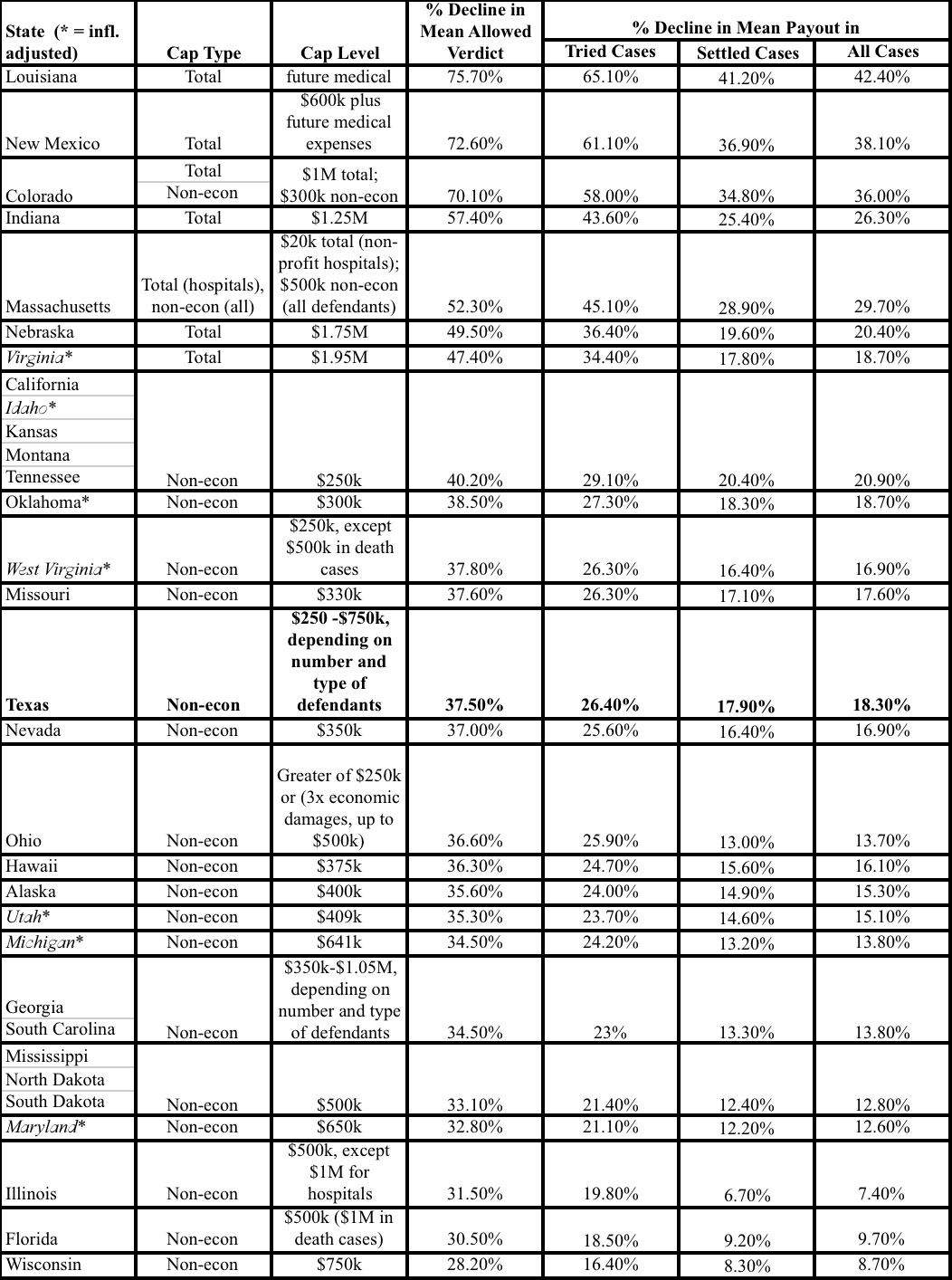
Last summer, Tom Baker, professor of law and health sciences at the University of Pennsylvania School of Law and author of “The Medical Malpractice Myth,” was interviewed by a free lance author for a piece (published in the new york times blog) on medical liability.

He believes that making the legal system less receptive to medical malpractice lawsuits will not significantly affect the costs of medical care (because he measures the cost of liability as a percent of total health spending, yet he ignores that the burden falls disproportionately upon physicians). He acknowledges that:

  • "The medical malpractice system only works for serious injuries...
  • Lawyers discourage people from bringing suits if their injuries are not serious in monetary terms — a poor person or an older person who can’t claim a lot in lost wages ...
  • Gerontologists’ premiums are exceedingly low."

Still, he opposes caps on pain and suffering because (in states with caps) a plaintiff gets reimbursement of medical costs in principle... "(but) in fact, they don’t, because the lawyer has to be paid. These cases can cost $100,000 to $150,000 to bring, so the patient has to deduct that amount from any award. I’ve had lawyers tell me they would not take a case ... even if it’s a slam-dunk. The damages wouldn’t be enough."

So why is congress afraid to remove the lawyers from the equation - and allow a reliable system of justice that compensates victims better and at less cost to the health care system?


Friday, December 18, 2009

Senators to be Pilloried

In the NY Times are two columns (link to a, link to b) suggesting that passing the Senate Health care Bill is worthwhile, despite its shortcomings. The shortcomings of the bill highlight the shortcomings of our political process.

In 'column a' David Brooks asks if the bill will "put us on a path toward the real reform, or does it head us down a valley in which real reform will be less likely"? He worries that "it will slow innovation. (Because) Government regulators don’t do well with disruptive new technologies ... (and) We’ll shovel more money into insurance companies". Yet his worries about the costs could easily be addressed (and the cost curve bent) if only the reformers would shovel less money to the insurance industry and instead give doctors the incentive to innovate - remember Gawande's accountable care organizations.

And we don't need new demonstration projects. Here in the downstate New York region, a hospital network clinically integrated (a huge hurdle were it a physician network) then emerged, to the consternation of the payers, as the low cost health care provider in its region!

In 'column b", Paul Krugman describes some Senators as "motivated largely by a desire to protect the interests of insurance companies."

Protection of the insurance companies is anti consumer - it is the enemy of physicians, patient interests and meaningful health care reform. Those Senators, and their bill should be pilloried.

Thursday, December 17, 2009

Choice Worth Fighting For?

According to the WSJ, Aetna Inc. spent less money on patient care for some small businesses than it originally reported. The Senate Committee on Commerce, Science and Transportation said Aetna overstated by $4.9 billion the amount of money it spent on patient care for small businesses. Aetna said the error was a simple mistake.

Last month, the committee chastised Cigna Corp. for mislabelling $5 billion in premiums.

Wednesday, December 16, 2009

Sen Lieberman and the Health Insurance Industry

Mr. Lieberman now opposes both public option and early medicare buy-in, a change in position the senate majority leader has described as 'vexing'.

According to the WSJ, senate aides recalled a September interview with the Connecticut Post, in which Mr. Lieberman suggested giving people 55 and older "an option to buy into Medicare early."

The NY Times noted that Mr. Lieberman has taken more than $1 million from the industry over his Senate career. He ranked second in the Senate in contributions from the industry in 2006.

While he does seem to recall the industry contributions, what has become of his 'commitment' to health care reform?

Saturday, December 12, 2009

Its Not Health Care Reform If the Doctor is Not In

Centrist senators raised concerns about a major new element of the (senate) legislation, ... (that to) expand Medicare to cover some people ages 55 to 64.

Senator Olympia J. Snowe, Republican of Maine, said Democrats were moving to expand Medicare “without really understanding the ramifications ... I just don’t think it’s a policy we should embrace.”

This comment from US Senator George LeMieux (R-FL), 'It's not health care reform if the doctor is not in' begs that most important question yet to be considered.


Tuesday, December 8, 2009

Oxford Expands Fee Schedule to Non-Par Physicians - 'Free' Market?

Oxford has notified several New York physicians of a change from 'charge-based' insurance reimbursement (including the fraudulent UCR) to 'fee-schedule' based out of network reimbursement.

According to the notification, out of network reimbursement will be limited to an amount of 140% of the published medicare reimbursement amount.

We first learned about the program, as applied to physicians, in an article which appeared in MSSNY News of New York, October 2009. In the article, Sanford P. Cohen, Chief Regional Medical Officer, UnitedHealthcare explained that the MNRP payment would be an option that could be elected by an employer. Cohen said that it 'will be based on 110% of the current year payments stipulated for Medicare patients by the Center for Medicare & Medicaid Services (CMS)'.

The schedule-based MNRP program was implemented in New Jersey in January 2009. At the time it applied to Hospitals (inpatient and outpatient), Free-standing ambulatory surgery centers, Free-standing radiology centers, and Free-standing laboratories.

Among the stated goals of the program is the promotion of provider participation and consumer choice. But this is a dangerous and anti-competitive precedent. If allowed, this program:
  • Harms Physicians - it further reduces a plan's incentive to negotiate with participating physicians, as an insurer's exposure is limited, irrespective of whether a physician is in network or out of network.
  • Harms Consumers/Patients - it strips much of the value from an out of network benefit, a benefit that 70% of insureds currently pay extra premium for.


Sunday, December 6, 2009

Freshman Amendment to Senate Bill - Draft

A group of freshman democrat senators have crafted a proposal to contain costs in the senate bill (PPACA). The proposal would allow an array of pilot projects aimed at cutting medical costs to be expanded more rapidly if there is evidence that they are successful in reducing expenses.

on administrative simplification they offer:

  • "Health Care Fraud Enforcement: We direct HHS to utilize technology to prevent fraudulent, abusive or improper payments prior to payment of claims".
as a physician, the legislation seems abundant in its focus on preventing payments - i would seek something that might enable us to be paid.

  • "Eliminating Legal Barriers to Care Improvement: We would require GAO to study current law and regulation to identify barriers that may impede providers’ ability to improve the quality of care and the ability to aggressively implement the innovative delivery system reforms PPACA makes possible".
this would be helpful, particularly if it results in relaxation of antitrust barriers to collaboration, accountable care organizations, and gainsharing. But shouldn't this be studied prior to health care reform?

Mostly, not unlike their senior colleagues, the freshmen have trouble unleashing the potential harnessed by the physicians.


Friday, December 4, 2009

Grand Bargain no Great Deal

Economist Paul Krugman describes health care reform as a 'Grand Bargain', "coverage for (almost) everyone, tied to an effort to ensure that health care dollars are well spent."

He continues that well respected economists "are seriously impressed by the cost-control measures in the Senate bill, which include efforts to improve incentives for cost-effective care, the use of medical research to guide doctors toward treatments that actually work, and more ... 'the best effort anyone has made'...”

If Krugman senses a bargain, he's no horse trader. While economists may be 'seriously impressed', physicians (Gawande, Jauhar) know that meaningful and sustainable cost containment can result only from innovation - physician driven, physician centered innovation.

The 'medicare commission' is inadequate for the task and the current antitrust environment presents a hurdle barely addressed in the proposed legislation.


Tuesday, December 1, 2009

"Share the Savings ... See Them Grow" - Sandeep Jauhar, MD

In a New York Times essay, Sandeep Jauhar, MD responds to the CMS plan to award bonuses to hospitals that lower readmission rates. He believes that, instead, some of that money should be shared with doctors.

"Current law prohibits hospitals from paying doctors for reducing hospital services, even if the goal is to provide more efficient care. But such “gainsharing” will align doctors’ incentives with broader cost-cutting goals.

Our system needs to provide inducements to decrease the amount of health care ... especially (to counter) ... the current incentives that encourage (un-coordinated care and) rampant over-utilization".

His conclusion could not be better stated, "Unless doctors view cost-cutting goals as their own, policy makers don’t stand a chance of achieving them".

Link to other Sandeep Jauhar, MD Articles

Link to Essay