- protected the patient,
- shielded doctors and hospitals from unscrupulous trial lawyers eager to make a quick buck at the system's expense.
- capped non-economic damages at $250,000 per defendant, or up to $750,000 per incident,
- no cap on more easily determined economic damages, such as lost wages or cost of medical care due to injury.
- ended the practice of allowing baseless, but expensive, lawsuits to drag on indefinitely, requiring plaintiffs to provide expert witness reports to support their claims within four months of filing suit or drop the case.
And what about the money that used to go to defending all those frivolous lawsuits? You can find it in budgets for upgraded equipment, expanded emergency rooms, patient safety programs and improved primary and charity care.
Link to Gov Perry's Op-Ed piece

great piece on med liability - it shows what reforms work. big difference for texas.
ReplyDeleteas an argument to let states determine its own solutions - new york is an example of what doesn't work
It's a pity NY's trial lawyer Speaker is, by default, the most powerful man in Albany.
ReplyDeletetwo of your moderators participated in the 'white house conference call' 8:30 pm tonight. The call was moderated by Dr.Kavita Patel, who serves with Senior Adviser Valerie Jarrett and has worked as a practicing Internal medicine physician. According to her information ~ 2300 physicians participated.
ReplyDeleteduring the q&a phase a questioner asked about liability. dr patel's response included reference to the presidents opposition to caps, and in particular to the adverse texas experience. does anyone know what was adverse about the texas experience?
Physician Leadership was on the call:
ReplyDelete“Torture on the telephone!”
That was my reaction Tuesday evening when I dialed into what was billed as a “Physician Briefing Call” by the White House Office of Health Reform. Some 2700 physicians listened for one hour with me while a trio of Obama administration staffers, including one former primary care physician, made an anemic attempt to convince us that the President’s team understands what physicians need from Health System Reform in order to practice quality medicine in the 21st century.
The Forbes.com article by Dan Gerstein, “Their Own Worst Enemy,” outlines the failure that the administration has had in communicating to the public its case for Health Care Reform. What I find most encouraging in this article is that no one is blaming physicians in general, or organized medicine in particular, for the potential demise of this legislation.
That is significant for several reasons. Primary among them is that even if comprehensive reform proves unachievable in the current environment, we will still need legislation by year’s end to forestall a 20% reduction in physician Medicare payments. Other components may also be addressed incrementally. Having been responsibly engaged in the process will bode well our profession in future negotiations.
In the 20 years that I have been participating in developing MSSNY’s legislative agenda, I have not previously witnessed the volume and diversity of physicians’ opinions on any other legislative issue. Conference calls this week with specialty society leaders on Tuesday evening, county society presidents on Thursday, and a meeting in Amsterdam (NY) with the Montgomery County Medical Society demonstrated to me that our profession will continue to have an active voice in this ongoing debate. Continue to follow the progress of this legislation through this publication and the www.mssny.org web-site. Meet with your Congressional representatives and let us know their responses to your inquiries.
dh
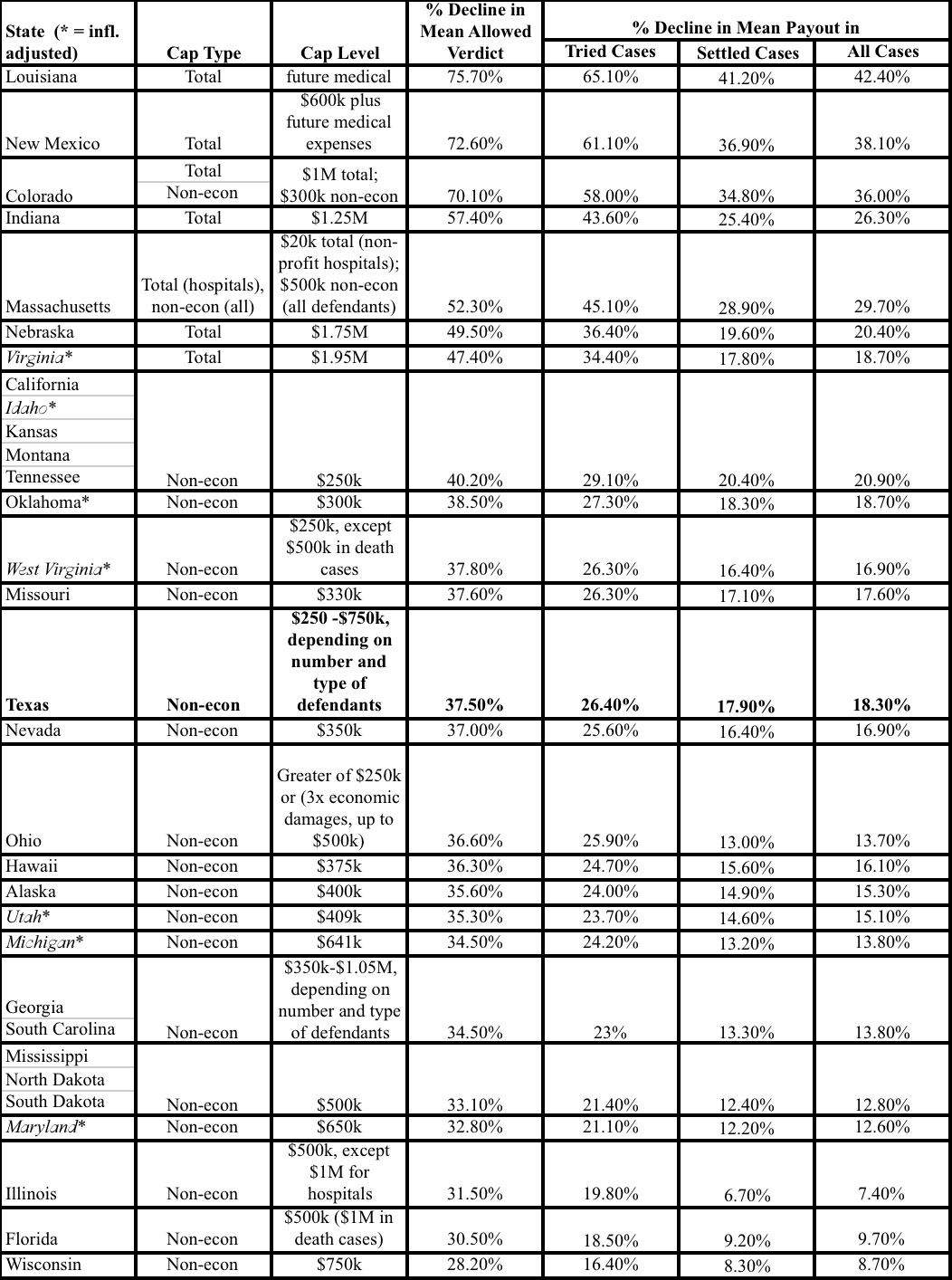
interesting table that relates caps to payouts:
ReplyDeletehttp://www.volokh.com/files/davidh-Table_10.jpg
'Focusing only on cap level, a cap of $250k reduces payout across all cases by 20.9%. Increasing the cap to $350k reduces payout across all cases by 16.9%. Increasing it again to $500k reduces payout to 12.8%. A further increase to $650k reduces payout by 12.6% -- virtually the same impact as the cap of $500k.'
regarding the white house conference call:
ReplyDelete1) the nys ophthalmology society today issued a statement indicating ambivalence as to the value of the call. your administrators are seeking permission to post this statement or a link here
regarding dr patel's characterization of the texas experience as 'adverse', we have instead been turned on to this:
ReplyDeletehttp://www.allbusiness.com/services/legal-services/4086280-1.html
'"The tool remains in place [for litigation]," he said. "The goal was to reduce verdicts that didn't represent the injuries suffered or the value of a dollar, and to root out non-meritorious cases.
"We're still seeing high indemnity payments to patients. It appears the reforms are having their stated effects, but preserving legitimate cases," Opelt said.'