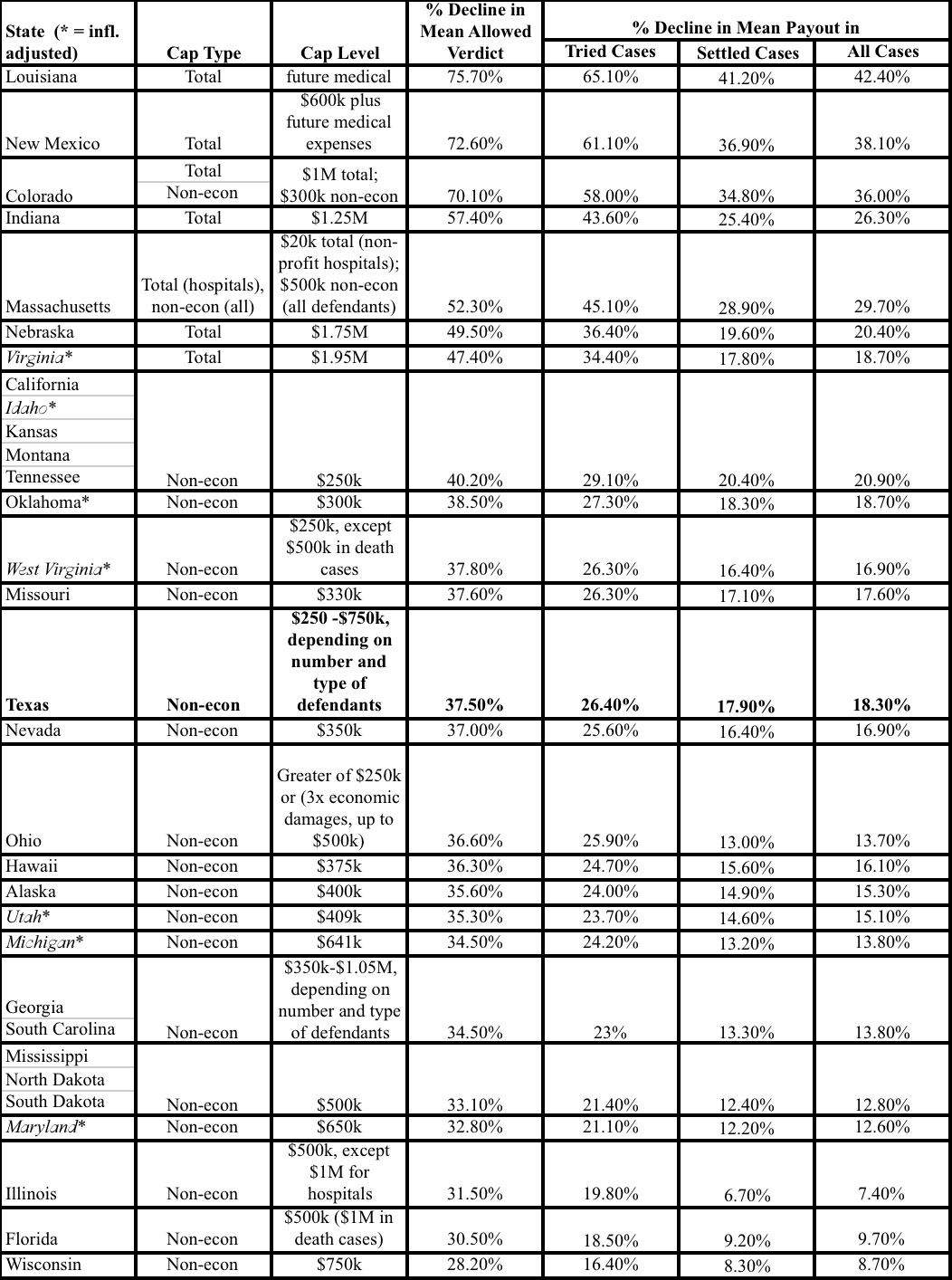
In order to get physicians onboard with healthcare reform, the administration should push to reform the practice environment. Polling many physicians of disparate backgrounds and political persuasions, we find one area of unanimity. The present system of adjudicating claims of malpractice must be changed.
Duke University’s Donald H. Taylor, Jr. writes in the North Carolina News&Observer:
…A successful malpractice system would protect patients from harm via a deterrent effect of lawsuits, compensate patients for harm and exact justice. In addition, a good system would protect physicians from frivolous suits, identify substandard physicians so that medical licensure boards could remediate them or remove their licenses and provide a clear signal to insurers regarding the risk of insuring a physician.
Our malpractice system does none of these well.
http://www.newsobserver.com/opinion/columns/v-print/story/1638305.html
A large number of lawsuits are filed when no malpractice has occurred. Conversely, many cases of real negligence do not result in a lawsuit. Not only is compensation inequitable, but the system itself is ponderously slow. It takes about five years from summons & complaint until trial or resolution. Moreover the costs involved with filing, answering, expert opinions, depositions and the cost of trial are such that for every dollar paid a successful claimant, half again as much goes to administer this system. While the costs of malpractice may only amount to 2% of healthcare costs, this still amounts to over twenty billion dollars which is not a trifling sum, even when a budget of trillions is being considered.
And then there’s the cost of defensive medicine, which has been estimated to cost $100 billion annually. It appears that as the administration scrambles to answer concerns of runaway cost estimates, they are avoiding an obvious chance to bend the cost curve favorably – reform the US medical malpractice system. Professor Taylor lists several suggested modifications to the current system. Suffice it to say our medmal system can be reformed so that it is efficient, equitable and evidence-based. Reform medmal and achieve both cost-savings and physician support. Win – Win.
Art Fougner

Hear hear!
ReplyDeleteasked off-line, why the president - who acknowledged liability as a driver of health care costs - appears to be lax with regard to liability reform, i responded as follows:
ReplyDeletewhile there is surely some role to partisanship, campaign contributions, ideology, etc, a politician ultimately needs to respond to the electorate, or he risks losing a re-election bid. currently, the dems think that lawsuits protect the electorate from the evils of any number of threats, including bad doctors.
for example, the public could be endangered by manufacturers inclined to market unsafe products seeking to maximize profit. the thinking goes, that lawsuits are both a means of compensation and a powerful deterrent. while that may be true for corporate defendants, our task is to show that this does not apply to med mal.
only by framing med mal as the exception to the rule, can we make the politicians consider the entirety of the evidence for liability relief.
I'd say Obama has at least 40 million reasons for not backing meaningful tort reform.
ReplyDeleteAre Lawyers Calling The Shots On Health Care Reform?
ReplyDeleteVia Memeorandum:
In a New York Times op-ed, our Cheerleader in Chief once again sings the praises of a government takeover of our health care. Actually, a better analogy for Obama might be the circus barker. “Come on in folks! Get your seat to THE GREATEST SHOW ON EARTH! Just as the barker promises that the audience will experience amazing feats the president is making promises that sound too good to be true.
The president says that we are going to cover an additional 46 million people and cut costs without rationing. Now that is an amazing feat! Funny, not everything that would result in savings is on the table. Nowhere in any of the proposed bills are there provisions that would cap payouts on malpractice suits or put an end to frivolous lawsuits that cost billions in legal fees, lost productivity and increased tests and procedures that are performed defensively. According to Dr. Marc Siegel, forty percent of all malpractice suits are illegitimate, yet these “costs” have been completely ignored.
The American Thinker wrote in March of 2008 that the Democratic Party has become The Lawyer’s Party. There can not be meaningful health care reform without addressing the problem of frivolous malpractice suits. In turn, there will not be a meaningful discussion on frivolous malpractice suits so long as the president and his party are riding around in the pocket of the lawyers who bankroll their every move and if health care is any indication, influence their every decision.
If the president and his party really care about reform, and are not just using this as a power grab, then they should put everything on the table.
http://carolyntackettscloset.blogspot.com/2009/08/are-lawyers-calling-shots-on-health.html
Here's a Blast from the Past:
ReplyDelete"...A SPECIAL PROBLEM: MALPRACTICE SUITS AND
MALPRACTICE INSURANCE
One reason consumers must pay more for health care and health insurance these days is the fact that most doctors are paying much more for the insurance they must buy to protect themselves against claims of malpractice. For the past five years, malpractice insurance rates have gone up an average of I o percent a year-a fact which reflects both the growing number of malpractice claims and the growing size of settlements. Many doctors are having trouble obtaining any malpractice insurance.
The climate of fear which is created by the growing menace of malpractice suits also affects the quality of medical treatment. Often it forces doctors to practice inefficient, defensive medicine–ordering unnecessary tests and treatments solely for the sake of appearance. It discourages the use of physicians’ assistants, inhibits that free discussion of cases which can contribute so much to better care, and makes it harder to establish a relationship of trust between doctors and patients.
The consequences of the malpractice problem are profound. It must be confronted soon and it must be confronted effectively–but that will be no simple matter. For one thing, we need to know far more than we presently do about this complex problem.
I am therefore directing–as a first step in dealing with this danger–that the Secretary of Health, Education, and Welfare promptly appoint and convene a Commission on Medical Malpractice to undertake an intensive program of research and analysis in this area. The Commission membership should represent the health professions and health institutions, the legal profession, the insurance industry, and the general public. Its report–which should include specific recommendations for dealing with this problem–should be submitted by March 1, 1972."
Richard M. Nixon