When President Obama addressed the American Medical Association earlier this year, many in attendance criticized the fact that he brought up many of the issues facing physicians but didn't say much about what he would do to make sure they would be addressed as we move forward with health care reform. The one thing he made clear was that he would not support a cap on non-economic damages, something physicians have advocated for years. Naturally, the audience responded by voicing their disagreement with his stance on the issue. With so much uncertainty about what comprehensive health reform would look like, the only clear detail was that a top priority for many physicians was a non-starter.
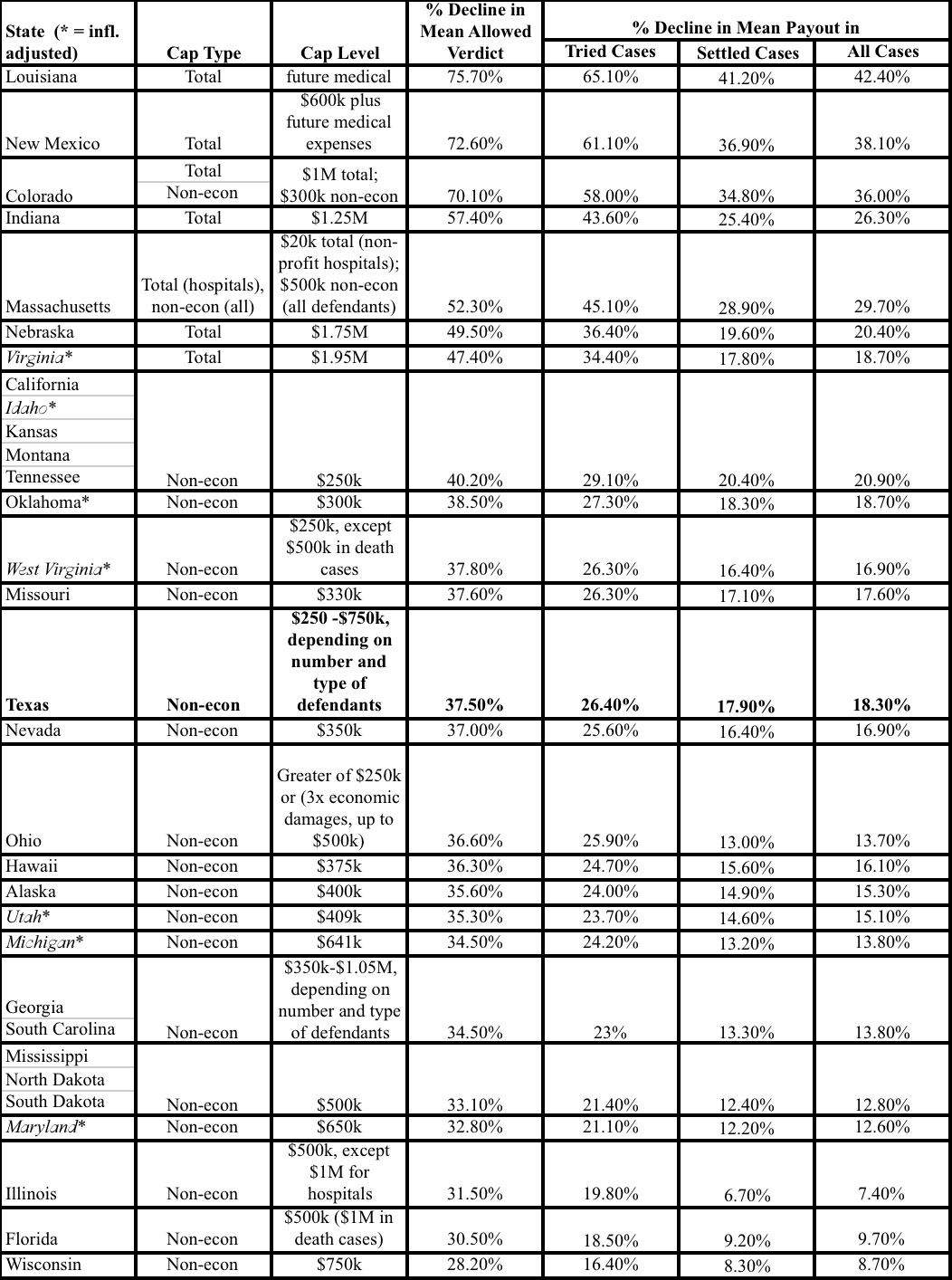
In 1975, California passed the Medical Injury Compensation Reform Act (MICRA), which imposed a $250,000 cap on non-economic damages in medical malpractice suits. This legislation was adopted as a result of a medical liability crisis in California in the early 1970s. Not unlike today, many physicians then saw a rapid increase in their liability premiums due to rising frequency and payouts from malpractice suits. The result was that many physicians stopped providing high-risk procedures, left the state or stopped practicing altogether, leading to a physician shortage in many areas of the state. Anyone familiar with the liability crisis looming in states like New York, Illinois and Florida know this is a natural progression of medical liability that is left unchecked. Thirty-four years after MICRA and the resulting caps, California has some of the lowest liability premiums in the country. Texas followed suit in 2003. After it's implementation, Texas found they couldn't keep up with licensure applications for all the new physicians who elected to move to a state with a more favorable liability climate.
President Obama has, on several occasions, made reference to physician utilization and the suggestion that many patients receive "unnecessary care" based on increased reimbursements for services rendered. There is no denying that the provision of medical care in this country presents a perverse incentive: the ones who decide how much medical care patients need are the same ones who reap the benefits from providing more medical care under a fee-for-service model. The president and Congress are right in their attempts to identify instances where funds are utilized unnecessarily and remedy these. Their support for improved communication via health information technology and coordination of care through the medical home are examples of their commitment to improve utilization. Taking any discussion of caps on non-economic damages, however, is not. Accusing physicians of spending money that doesn't improve patient care while letting trial lawyers off the hook for their role in compromising patient care is just plain irresponsible.
Physicians are charged with providing necessary medical care. Similarly, lawyers are charged with protecting patients from gross negligence. Taking care of patients is both a privilege and a tremendous responsibility. The purpose of medical liability is to keep gross negligence in check, punish inappropriate physicians and, when necessary, remove them from practice. Not only does the current liability system fail to protect patients from gross negligence, it also fails to protect physicians who practice appropriately but whose patients suffer bad outcomes. Trial lawyers cream-skim cases where both potential payouts and likelihood of settling before trial are high, irrespective of whether inappropriate care was provided. Additionally, lawyers often promise to not charge a fee unless the patient is compensated as a result of the suit. With nothing to keep frivolous lawsuits in check and an incentive to select high-paying cases over ones where patients have experienced gross negligence leaves neither physicians nor patients protected. Only trial lawyers stand to benefit from this system.
Acknowledging that physicians have a perverse incentive to provide more care is important. Where President Obama and Congress have failed patients all across this country is their failure to acknowledge the perverse incentive the Democrats have to support trial lawyers. For years, trial lawyers have supported Democratic candidates in exchange for their obstruction in any attempts to achieve meaningful liability reform. In many states where liability crises loom large, Democrats have told physicians for years that caps on non-economic damages were off the table. Caps are certainly not a perfect solution: opponents rightly argue that limiting non-economic damages prevents some patients from seeking retribution in cases of gross negligence. But perpetuating a system that fails to protect physicians or patients while compromising access to care and wasting funds only calls the credibility of its Democratic supporters into question.
We as physicians are the guardians of the health and well-being of our patients. We are charged with ensuring that they get all necessary care but have the responsibility of preventing wasteful spending. As health care spending grows to nearly 20 percent of the GDP and the number of uninsured people in this country approaches 50 million, we cannot afford a system that wastes as much money as our current one. President Obama was right to recognize this and advocate for change to remedy what ails us. But holding physicians accountable while giving the trial lawyers a pass is not only irresponsible, it is nothing more than politics that compromises the health of our nation.

i like what you say, especially the pass given to the trial lawyers.
ReplyDeletethe assertion that obstruction to medical liability reform resides with a single political party is (to me) intuitively obvious - but the recent triumvirate, when the republicans held the white house and majorities in both the senate and the house, bore no reform either. this suggests that the forces against reform may cross party lines.
the solution will require cleverness indeed.
That's actually a great point. Though the Republican party tends to be supportive of caps on non-economic damages, we never saw anything under the last administration pushing them, though Bush was often vocal about a need to support them. Part of the problem is that liability is regulated at the state and not the national level.
ReplyDeleteThe link to Bob Beckel's article makes some interesting points. I do think supporting caps has the potential to shift the debate and bring physicians, a currently divided force despite the AMA stance, together as a collective voice advocating reform. Everyone other interest group has been very clear that they are willing to make some sacrifices because the status quo is an unsustainable system. It's time for the trial lawyers to start following suit.
is this the link to which you refer?
ReplyDeletehttp://www.realclearpolitics.com/printpage/?url=http://www.realclearpolitics.com/articles/2009/08/18/dems_ace_in_the_hole_on_health_care_tort_reform_97919.html
an important reason why the med mal system of litigation cannot achieve its stated objectives (beyond compensation of parties) - from the ny times article on the us supreme court decision on the iqbal case - is the low barrier to entry:
ReplyDelete'For more than half a century, ... all a plaintiff had to do to start a lawsuit was to file what the rules call “a short and plain statement of the claim” in a document called a complaint. Having filed such a bare-bones complaint, plaintiffs were entitled to force defendants to open their files and submit to questioning under oath.
This approach, particularly when coupled with the American requirement that each side pay its own lawyers no matter who wins, gave plaintiffs settlement leverage. Just by filing a lawsuit, a plaintiff could subject a defendant to great cost and inconvenience in the pre-trial fact-finding process called discovery.... (subjecting) defendants to millions of dollars in discovery costs.'
i am unaware of any study that compares the malpractice costs in venues that have high settlement rates with costs in low settlement venues. attorneys i have spoken with on the issue have agreed that intuitively, high settlement rates tend to increase the volume of litigation.
Tom Daschle in June 2009 - Tort Reform is ON the table. So what happened? And how do we get it back?
ReplyDelete